
-
Weather Station Electronics kit
Regular price $27.95Regular priceUnit price per -
FM Radio Assembly Kit
Regular price $29.95Regular priceUnit price per -
LED Christmas Tree Kit
Regular price From $19.95Regular priceUnit price per -
 Special Offer
Electromagnetic Cannon Kit
Regular price $29.95Regular priceUnit price per$32.95Sale price $29.95Special Offer -
Digital Clock Electronics Kit
Regular price From $26.95Regular priceUnit price per -
Handheld Game Electronics Kit
Regular price $26.95Regular priceUnit price per -
 Special Offer
4-Digit Digital Clock kit
Regular price $26.95Regular priceUnit price per$27.95Sale price $26.95Special Offer -
 Special Offer
Morse Code Electronics kit
Regular price $21.95Regular priceUnit price per$23.95Sale price $21.95Special Offer -
DIY Bluetooth Speaker Kit
Regular price $32.95Regular priceUnit price per -
 Special Offer
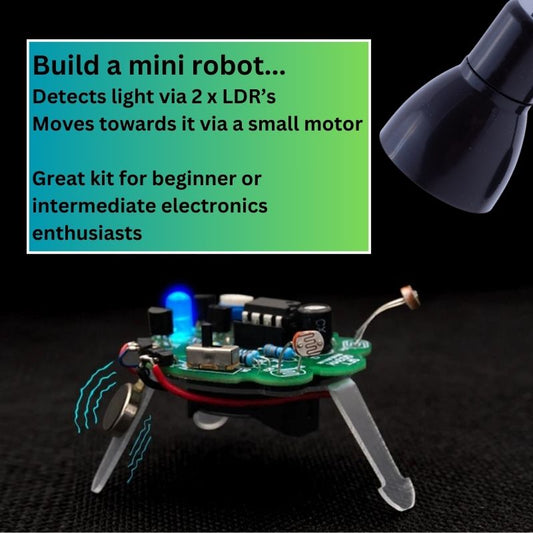
Photosensitive Robot Kit
Regular price $16.95Regular priceUnit price per$18.95Sale price $16.95Special Offer -
Ultrasonic Levitation Kit
Regular price $26.95Regular priceUnit price per -
Smart Car Electronics Kit
Regular price $21.95Regular priceUnit price per


Learn more about our circuit building kits
Our STEM electronics kits make it easy to learn how electronic circuits work while building real gadgets and devices. These hands-on soldering project kits help kids, teens, and adults learn electronics step by step — no experience needed.
Each electronics kit includes real components for DIY electronic projects like sensors, LEDs, resistors, transistors, capacitors, digital displays, switches, and microchips (integrated circuits). With each soldering practice kit, you’ll discover how everyday devices work while learning the art of electronics.
Start simple with a basic electronics kit or an Arduino UNO starter kit, then as your electronics skills grow, move up to more advanced electronics hobby kits. Every project is designed to be fun, safe, and educational — a perfect example of learn-by-doing STEM learning.
Our educational electronic kits come with everything you need, including clear, detailed instruction manuals, packed with photos, and all parts required to build your own electronics. They’re ideal for classrooms, after-school clubs, homeschooling, or simply as a fun and educational hobby.
If you're looking for a unique educational gift or STEM gift idea, look no further! These kits make brilliant tech gifts for teens, and are a well-established favourite gift for adults too! Looking for electronics kits for engineering students? Look no further; we have kits that will challenge all skill levels, including some challenging SMD soldering practice kits!
Start your electronics hobby today! This is a fantastic, rewarding hobby that is enjoyed by people of all ages all over the world. To help you get started, our diy electronics kit collection includes many electronics kits for beginners and loads of fun electronics kit for kids in which they'll build their own electronics to play with. Want to find out more? Learn more in our Ultimate Guide to Electronics.
Do you have questions about getting started with electronics? Contact us and we'll be happy to help.
Electronics STEM Kits – Frequently Asked Questions
Q: What are electronics STEM kits?
A: Electronics STEM kits are hands-on learning kits that teach the basics of electronics by building real working circuits. Instead of only reading about electronics theory, you learn by assembling projects using components like LEDs, resistors, capacitors, sensors, and microchips. This practical approach makes complex electronics concepts easier to understand and far more engaging than traditional learning methods.
Q: What do electronics kits usually include?
A: Most electronic hobby kits include the electronic components required to build one or more working projects. Common parts include resistors, LEDs, capacitors, switches, sensors, wires, and integrated circuits. These parts allow you to build circuits and learn how electricity flows through a system while experimenting with real electronic components.
Q: Are electronics kits suitable for beginners?
A: Yes. Many soldering kits for beginners are designed specifically for people with no previous experience. Step-by-step instructions guide you through each stage of the project so you can learn the fundamentals of circuits, voltage, and electronic components as you build. DIY electronics kits are widely used by schools, hobbyists, and STEM clubs because they make learning electronics approachable and fun.
Q: What age are electronics STEM kits suitable for?
A: Most electronics kits are suitable for kids, teens, and adults (adult supervision required for under 16's). Younger learners can start with a basic electronics kit, while older students and hobbyists may enjoy more advanced electronics projects involving sensors, actuators, or microcontrollers. Because electronics is learned through experimentation, it is a rewarding hobby for people of almost any age.
Q: What skills can you learn from electronics kits?
A: Building electronics projects helps develop a range of useful STEM skills. These include problem-solving, logical thinking, circuit design, troubleshooting, and basic engineering knowledge. As you experiment with components and build working circuits, you also gain a deeper understanding of how everyday electronic devices work.
Q: Do I need previous electronics knowledge?
A: No prior knowledge is required for most stem electronics kit. Beginner kits typically include detailed manuals with diagrams and step-by-step instructions so you can follow along easily. As your confidence grows, you can move on to more advanced circuit building kits and start designing your own circuits.
Q: Are electronics kits good educational gifts?
A: Absolutely! STEM electronics kits make excellent educational gifts because they combine learning with creativity and hands-on building. Instead of passive screen time, these kits encourage curiosity and experimentation while teaching real science and engineering skills. They are popular STEM gifts for kids, teens, students, and adults interested in technology.
Q: Where should beginners start with electronics?
A: If you're completely new to electronics, the best place to begin is with one of our electronics kits for beginners that teaches basic circuits and components. The "Assembly and Usage Info" dropdown section on each electronics kit product page provides the difficulty level for the kit. Once you're comfortable building simple projects, you can move on to more advanced kits that introduce programming and microcontrollers.